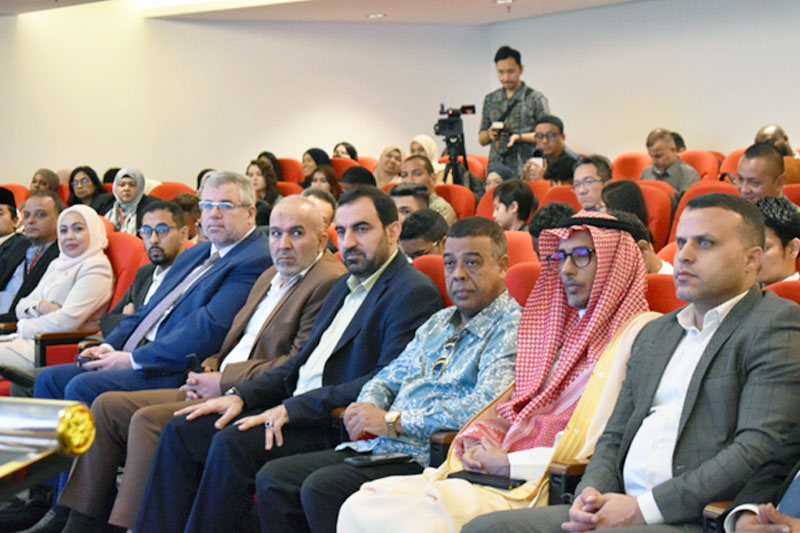
In collaboration with the Muslim World League Office in Malaysia, The International Civilizational Communication Centre (ICCC), organized an academic seminar on Thursday titled “The Civilizational Role of the Arabic Language” at ALFA University College in Subang Jaya, in celebration of World Arabic Language Day.
The world celebrates the Arabic language on 18 December each year in recognition of its civilizational role as one of the oldest living languages, spoken by more than 450 million people, and as the primary language of 22 countries. Arabic is also the language of the Holy Quran, which has bestowed upon it special honor and endowed it with a profound moral and cultural dimension that has shaped patterns of thought and discourse in Arab societies.
In her address during the seminar, the Vice-Chancellor of ALFA University College, Prof. Dr. Nurliza Binti Muslim, stated that the Arabic language, with its deep civilizational roots and high expressive capacity, is not merely a working language, but rather a cultural and intellectual bridge connecting peoples, and a fundamental tool for promoting dialogue, mutual understanding, and peacebuilding in international relations. She also highlighted that Arabic combines precision with eloquence, making it an effective instrument for formulating official positions and conducting negotiations without confrontation.
Dato Sri Syed Hussein bin Abd Kadir Al-Habshee, Professor at AHAS KIRKHS, International Islamic University Malaysia (IIUM), noted that the use of Arabic in diplomatic work enhances mutual respect and reflects appreciation for cultural identity, thereby contributing to the building of more solid and sustainable relationships. He also pointed to the deep religious and emotional connection between the Malay people and the Arabic language.
Dato’ Wan Mohamad bin Dato’ Sheikh Abdul Aziz, President of the Muslim Scholars Association of Malaysia, addressed the role of the Arabic language in Islam, describing it as a fundamental necessity for the proper performance of acts of ibadah, such as prayer. He outlined several of the language’s distinctive features, including its eloquence, the presence of letters not found in other languages, and its rhetorical power, which allows profound meanings to be conveyed through few words. He also noted that love for the Arabic language stems from love for Islam and love for the Prophet Muhammad (peace be upon him).
Regarding the importance of the Arabic language, Dr. Baidar Mohamed Mohamed Hassan, Assistant Professor at the Faculty of Shariah and Law at Universiti Sains Islam Malaysia (USIM), highlighted its role in deepening the understanding of the original Islamic texts (the Quran and the Sunnah), preserving Islamic and cultural identity in the face of globalization and external influences, and empowering academic research in Islamic studies. He also emphasized the importance of keeping pace with digital transformation and artificial intelligence by positioning Arabic as a comprehensive language of knowledge and innovation in higher education.
The seminar was attended by a distinguished group of ambassadors, diplomats, deans, academics, and enthusiasts of the Arabic language.
The International Civilizational Communication Centre (ICCC) aims to strengthen ties between ASEAN countries and the Gulf Cooperation Council (GCC) countries by promoting dialogue among civilizations and cultures, fostering the values of tolerance and mutual understanding, and advancing these goals through initiatives in education, heritage, and youth development.
In the closing session, Dr. Mohammed Gharawi, Director of the Muslim World League Office in Malaysia, affirmed that the League is committed to supporting the Arabic language and has made its teaching and learning one of its core objectives. He explained that His Excellency the Secretary-General, Dato’ Seri Sheikh Dr. Mohammed bin Abdulkarim Al-Issa, places great emphasis on supporting initiatives to teach the language of the Holy Quran in service of Muslims around the world.